.svg)
.svg)


Your Implant Is Healed - Now What? A patient-friendly guide to the implant crown process
Reaching the restorative phase is exciting: the implant has been placed, healing has progressed, and it may be time to create the tooth you will see and use. The final crown appointment is not simply the same as placing a crown on a natural tooth. It involves identifying and coordinating several precisely fitting components.
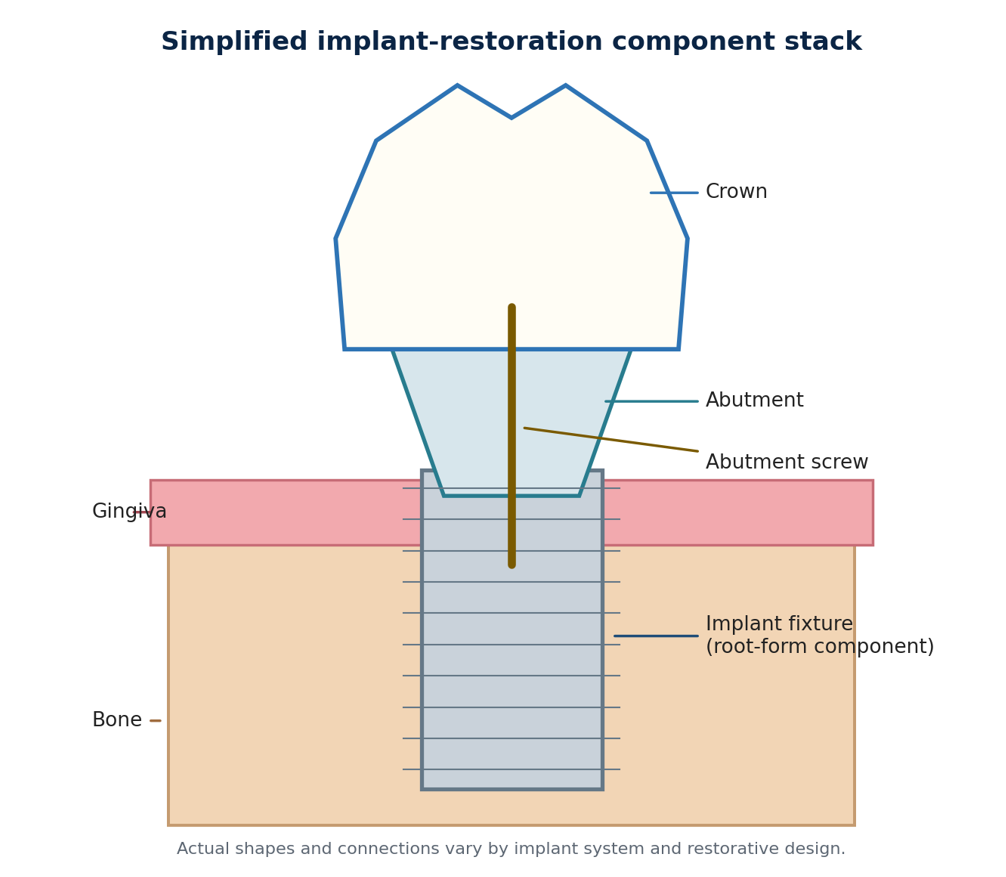
The four parts of a single implant tooth
- Implant fixture: The root-shaped component placed in the jawbone during surgery.
- Abutment: The connector that rises from the implant and supports the crown. It may be a pre-made size or custom-designed for the site.
- Abutment or prosthetic screw: The precision screw that secures components to the implant according to the implant system.
- Crown: The tooth-shaped restoration designed to match the size, form, colour, contact, and bite of the surrounding teeth.
Some modern designs combine the abutment and crown into one laboratory-made restoration, while others use separate pieces. The correct parts must match the exact implant connection. Components from different systems may look similar but are not automatically interchangeable.
Why your dentist may ask who placed the implant
Dental offices often restore implants placed by another dentist or specialist. That is common, but the restorative team needs to identify the implant brand, connection, platform size, and any parts already used. This information helps the team order the correct impression component, scan body, screw, driver, and abutment.
A USEFUL RECORD TO KEEP
Ask for an implant passport or copy of the surgical record showing the implant manufacturer, product line, diameter, length, platform, placement date, and surgeon. Keep it with your health records and share it whenever a new office treats the implant.
If records are unavailable, your dentist may review radiographs, contact the placing office, examine the existing healing component, or use implant-identification resources. Occasionally, more than one possibility remains and additional investigation is needed before treatment proceeds.
Step 1: Confirm that the implant is ready
The timing of restoration is individualized. Before beginning, the dentist confirms that the surgical site has healed appropriately and reviews the surgeon's recommendations. Bone quality, grafting, implant location, initial stability, medical conditions, and the planned bite all influence the schedule.
The gum should also be evaluated. Healthy tissue shape and enough room for a cleanable crown are important. If the tissue is inflamed, difficult to access, or not shaped as expected, the restorative appointment may be modified or postponed so the underlying issue can be addressed first.
Step 2: Capture the implant position
Unlike a natural tooth crown, an implant crown is not made from the shape of a prepared tooth. The laboratory or digital design software needs a highly accurate record of the implant's three-dimensional position and connection.
Your dentist may use a conventional impression or a digital scan. For a digital workflow, a small scan body is attached temporarily so the scanner can record the implant's position and orientation. With a conventional workflow, an impression coping transfers the same information into a physical model. Neither method is automatically best for every situation; implant number, angulation, depth, access, and the restorative system all matter.
- The implant connection and surrounding gum are recorded.
- The neighbouring teeth and opposite arch are scanned or impressed.
- Your bite is recorded so the crown can be designed in the correct relationship.
- For a visible tooth, shade, shape, photographs, and esthetic preferences may also be documented.
Step 3: Choose the supporting design
The abutment acts like the prepared tooth underneath a conventional crown. A stock abutment is manufactured in standard shapes and tissue heights. A custom abutment is designed for the exact implant position, gum contour, and restorative space. Customization can be useful when the implant angle, tissue form, or esthetic demands require more control, but it is not automatically necessary in every case.
Your dentist and laboratory also choose suitable materials. Strength, colour, tissue thickness, space, implant position, bite, repairability, and cost all influence the decision. There is rarely one material or abutment design that is best for every patient.
Step 4: Decide how the crown will be retained
An implant crown can usually be retained in one of two ways. A screw-retained crown is attached through a small access channel in the biting surface or back of the tooth. After the screw is tightened, the channel is sealed with tooth-coloured material. This design is often easier to retrieve if the restoration needs repair or the screw requires attention.
A cement-retained crown is cemented to an abutment, more like a traditional crown. This may be useful when a screw-access opening would emerge in an unfavourable location. The dental team must carefully control and remove excess cement, particularly if the margin is deep under the gum, because retained cement can contribute to inflammation.
THERE IS NO UNIVERSAL WINNER
Screw retention is often attractive because the restoration can be retrieved and no cement is left under the gum. Cement retention can still be appropriate when the implant position or esthetic design makes screw access unsuitable. The choice is based on the entire clinical situation.
Step 5: The crown delivery appointment
At the delivery visit, the dentist removes the healing component or temporary restoration and inspects the implant connection and surrounding tissue. The new abutment and crown are tried in and evaluated before final attachment.
- Fit and seating: The restoration must fully seat on the implant. A radiograph may be used when the connection cannot be confirmed visually.
- Contacts: The crown should contact neighbouring teeth appropriately without making flossing or cleaning impossible.
- Appearance: Shape, colour, gum contour, and smile integration are checked, especially in the front of the mouth.
- Bite: The dentist checks how the crown contacts during closing and side-to-side movements.
- Final attachment: The screw is tightened according to the implant manufacturer's protocol, or the crown is cemented with careful control of excess material.
- Cleanability: You should be shown how to clean around and beneath the final restoration with tools that fit the design.
Why the bite check matters
A natural tooth has a periodontal ligament that allows slight movement and provides sensory feedback. An implant is more rigidly connected to bone. Careful bite adjustment helps reduce unnecessary stress on the crown, screw, and implant system. Your dentist may recheck the bite after you have used the restoration because contacts can change as teeth move or restorations wear.
If you clench or grind, your dentist may discuss a night guard. This is an individualized decision based on your habits, wear patterns, number and position of implants, other teeth, and the type of restoration; not every implant patient automatically needs the same appliance.
What should the new crown feel like?
The crown may feel noticeable at first simply because the space has been empty or covered by a smaller temporary part. Mild gum tenderness can occur after the tissue is manipulated. The crown should not feel mobile, painfully high, or impossible to clean. You should be able to chew comfortably once the dentist's post-appointment instructions allow it.
CALL PROMPTLY IF
The crown feels loose, rotates, clicks, or hits before your other teeth; pain or swelling increases; there is pus or a persistent bad taste; floss repeatedly catches or shreds; food trapping becomes significant; or part of the crown chips or fractures.
Frequently asked questions
Can an implant crown get a cavity?
The implant fixture and crown cannot decay like enamel. However, the neighbouring teeth can still develop cavities, and plaque around the implant can cause gum inflammation and bone loss. Daily cleaning remains essential.
Will the crown last forever?
No restoration can be guaranteed for life. Implant crowns and screws can function for many years, but they may loosen, wear, chip, fracture, or need replacement. Regular reviews help identify early mechanical and biological changes.
Why might the dentist take a baseline X-ray?
A clear radiograph at or near final restoration provides a reference for the implant connection and supporting bone. Future radiographs should be based on clinical need and can be compared with that baseline rather than interpreted in isolation.
What if another office placed my implant?
That is a common scenario. Bring any implant card, surgical report, radiographs, or correspondence you have. Correct identification may add a step, but it is important because the restorative parts and drivers must match the implant system.
After the crown is placed
- Follow the eating instructions provided for your specific restoration.
- Brush the crown-gum junction twice daily with a soft brush.
- Use the floss, interdental brush, water flosser, or other device demonstrated by your dental team every day.
- Do not use the implant to crack ice, shells, hard candy, or other objects.
- Keep your recommended maintenance visits so the gum, bone, bite, crown, and screw can be monitored.
The bottom line
Restoring an implant is a precision process. The dentist must confirm healing, identify the implant, transfer its position accurately, choose compatible parts, design a crown that is cleanable and esthetic, attach it correctly, and balance the bite. When those steps are combined with good home care and ongoing monitoring, an implant crown can provide a comfortable and natural-looking replacement for a missing tooth.
READY FOR THE RESTORATIVE PHASE?
Bow River Dental Centre can assess an implant placed in our office or by another provider, coordinate records and components, and plan a final crown designed for fit, function, appearance, and maintainability. Visit bowriverdental.ca to contact our Cochrane team.

.svg)
.avif)


.png)
